Introduction

Thirty-five years after the landmark reforms that reshaped India’s economy, what will it take to make India a developed country?

Thirty-five years after the 1991 economic reforms, India is a fundamentally different economy. GDP has expanded from roughly $300 billion in 1991 to more than $4 trillion today, making India the world’s fourth-largest economy. Per-capita income has risen sharply, while the country has emerged as a major destination for global capital and a significant player in services, digital infrastructure and, increasingly, manufacturing. Yet, the gains from three decades of growth remain uneven, with India’s per-capita income still well below that of developed economies.

The next phase is, therefore, more demanding. India’s stated ambition is to become a developed economy by 2047, when it marks 100 years of independence. Achieving that would require not just sustaining relatively high GDP growth for two decades, but raising productivity, incomes and the quality of jobs at scale. It will require India to ask whether high growth alone is enough, and what structural changes are needed to turn growth into broad-based prosperity. It will also require navigating a global economy being reshaped by geopolitics, technology, climate change and shifting supply chains.

The third edition of the platform will examine what it will take—and what could stand in the way of—India’s leap to 2047. 

The conversations will explore some fundamental questions: 

  • Can India create enough productive jobs to translate growth into higher incomes? 
  • Can manufacturing become a larger and more competitive engine of growth? 
  • What reforms are needed to unlock more private investment and capital? 
  • Can AI and technology deliver a meaningful productivity dividend? 
  • Is India’s infrastructure, energy and human capital capacity keeping pace with its ambitions? 
  • How should India navigate a more fragmented global economy? 
  • What would it take to make the transition from a fast-growing emerging economy to a genuinely developed one?
  • The five roundtable conversations would collectively answer these seven questions on a progressive basis without forcing each roundtable to cover everything
  • Capital → production → technology → people → global positioning
Delhi Chapter (4th Nov 2026)

The Globalisation India Needs

Underlying question: Can India integrate more deeply with the world while retaining the strategic flexibility to pursue its own development path?

DISCUSSION POINTS

Can India pursue rapid growth in a world of tariffs, trade barriers and geopolitical fragmentation?
How should India balance strategic autonomy with deeper integration into global supply chains and markets?
What role can India play as global companies diversify beyond China?
How should India respond to the intersection of trade, technology, energy and national security?
Can India become more globally competitive without becoming excessively dependent on external demand or capital?
What does India's rise mean for its economic relationships with the US, China, Europe, Japan and the Global South?
What domestic reforms will determine whether geopolitics becomes an opportunity or a constraint?

Speakers

Image

Arun Kohli

MD & Country Head, India , Morgan Stanley
Image

Vetri Subramaniam

UTI Mutual Fund, MD & CEO
Image

Sonia Dasgupta

MD & CEO - Investment Banking, JM Financial Ltd
Image

Amit Jain

MD & India Head, The Carlyle Group
Image

Arnab Banerjee

MD & CEO, Ceat Ltd
Image

Madhurima Mukherjee Saha

Partner, JSA Advocates & Solicitors
Image

Ranjit Shah

Executive Vice-Chairman, Gaja Capital
Image

Saurabh Chatterjee

MD, ChrysCapital Advisors
Image

Swati Khemani

Founder & CEO, Carnelian Asset Management & Advisors

Mumbai (7th October 2026)

Capital for the Next Leap

Underlying question: Can India mobilise the capital needed for the next leap?

DISCUSSION POINTS

What scale of investment will India need to sustain high growth through 2047?
Can domestic savings and capital markets meet the financing needs of a rapidly expanding economy?
What is holding back private-sector capex, and what would unlock the next investment cycle?
How can India attract more long-term foreign capital while deepening domestic pools of capital?
What regulatory and institutional reforms are needed to make capital more accessible and productive?
Is India's financial system equipped to finance the transition from a $4-trillion-plus economy to a substantially larger one?

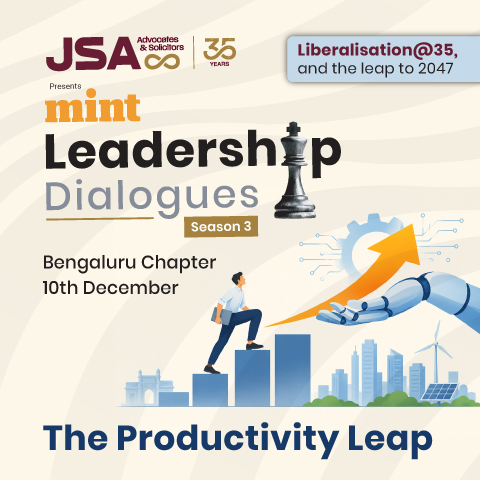
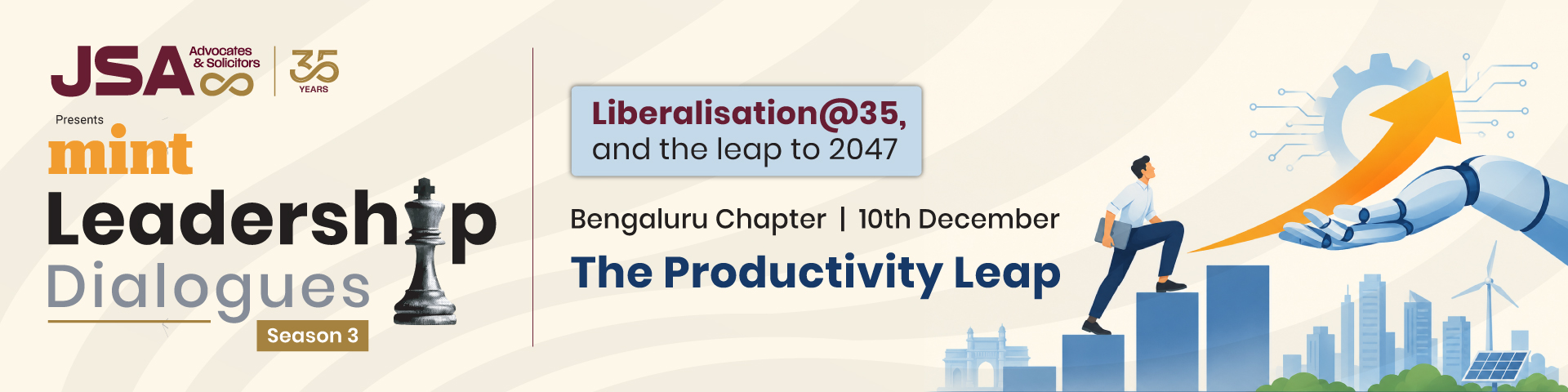
Bengaluru (10th Dec 2026)

The Productivity Leap

Underlying question: Can technology allow India to grow faster without simply adding more labour and capital?

DISCUSSION POINTS

 
Can AI deliver a meaningful productivity dividend across the Indian economy?
 
Will technology create more productive jobs—or displace the very jobs India needs?
 
How can AI move beyond India's technology sector into manufacturing, healthcare, finance, agriculture and public services?
 
What capabilities—compute, data, talent, R&D and digital infrastructure—will India need?
 
Can Indian companies use technology to leapfrog traditional stages of development?
 
What will determine whether AI becomes a genuine economy-wide productivity revolution rather than another technology cycle?
 
Does India have the institutional and human-capital capacity to absorb technological change?

Speakers

Image

Dammu Ravi

Former Secretary (Economic Relations), Ministry of External Affairs
Image

Mariano Agustin Caucino

Ambassador to India, Argentina
Image

Bharat Saxena

CEO, INOX Clean Energy
Image

Karan Mitroo

Partner, JSA Advocates and Solicitors
Image

Gurdeep Singh

Chairman & MD, NTPC
Image

Bikesh Ogra

MD & CEO, Jakson Green
Image

Mohit Bhargava

Country Director, India Energy & Climate Center, UC Berkeley
Image

Vineet Agarwal

MD, Transport Corporation of India Ltd.
Image

Sanjay Aggarwal

Advisor, Fortum Energy Holdings B.V. | Former Managing Director, Fortum India
Image

Vinoo George

Director, Avaada Electro Ltd.

Want to be part of it?

VCC Events opens up the avenues for participation. Join hands to be a part of India’s largest gathering of alternative investments leaders, industry stakeholders and Asia’s influential limited partners, general partners and marquee advisors. Your chance to actively participate and augment yourself as thought leaders.


Venue :

Bengaluru


Do you have any queries?

Drop us a line and we will call you.